Hi ,
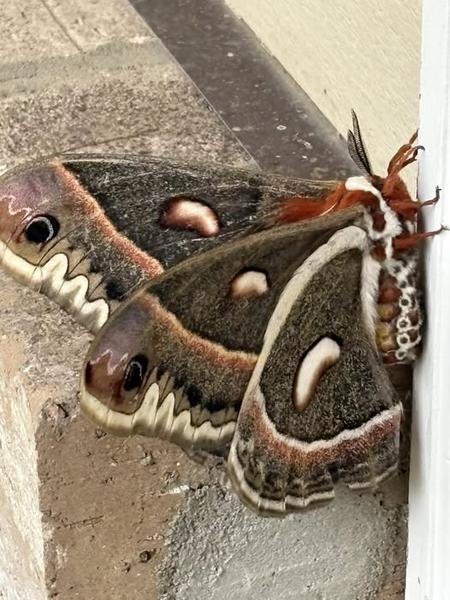
I found a very large moth clinging to our garage door frame this morning. I assumed she had someplace better to be, so I nudged her away.
To my dismay, she fluttered to the ground and continued frantically fluttering instead of flying—which drew the attention of the nearest cat, of course.
I shooed the cat away so the moth could hopefully leave in peace. She fluttered repeatedly but didn’t take off. I wondered if she was injured. Not wanting to touch her wings, I grabbed a stick to facilitate the ground rescue.
Unfortunately, the moth didn’t understand my plan and kept dodging the stick. It took at least two minutes—and a lot of wing-flapping avoidance—to finally get her on it.
My first goal was simply to get her off the ground, so I propped the stick against the wall of the house. She stayed there, but her whole body was shaking. She seemed terrified.
I
inspected her more closely and did notice some torn, frayed pieces on her wings. I decided that if she was going to die, it should at least be in more natural surroundings.
Carrying her on the stick, I relocated her to a
patch of brush in the woods, safely away from the cats. She immediately hopped from the stick onto a tree, then dropped down into the low-growing brush, fluttering continuously. I stood guard to make sure the movement didn’t attract another cat. Finally, the movement ceased, and I left the moth in peace.
Since then, I’ve learned a few things about moths. They’re nocturnal. Their duller coloring compared to their butterfly cousins helps camouflage them during the day while they rest. And after a nap, they have to “shiver” to warm up their muscles before they can fly again.
I didn’t know any of that.
I was just trying to invite the moth to go
enjoy the day rather than hang around our garage door. I thought I was helping, but in hindsight, I realize I disturbed a perfectly good nap and put her in harm's way.
Once again, I’m reminded that what I consider helping
may actually be harming—or at the very least, interrupting a natural course.
People don’t always need our “help” either. We may encourage—or even insist—they try things our way, convinced it will be better for them.
I learned something once about “helping” that I’ve never forgotten:
Unsolicited advice is criticism in disguise.
Ouch.
Being “critical” isn’t only being intentionally mean, fault-finding, or judgmental. Unsolicited advice-giving and “helping” can also be received as criticism because it suggests that what’s happening isn’t right—according to us—and perhaps there’s a
better way.
Our way.
If I ask someone in advance if they’d like my thoughts or suggestions, and they say yes, that’s a welcomed invitation to share. I try to start with, “I don’t really know for sure, but I’m wondering what would happen if…”
That helps me remember that I’m not always as smart as I think I am. I’m not God of their life, and I don’t know what’s best for them or anybody.
Honestly, I often don’t know what’s best for me, so how could I possibly know what’s best for you?
Like today with my moth friend—she wasn’t bothering anything, hanging there on our garage door.
I just assumed she’d be happier in nature, but she had chosen a safe, high place away from predators to rest.
Sometimes, we really do need to leave well enough alone. Improvements as we imagine them may turn out to be
harmful at worst—or offensive when perceived as criticism.
Self-improvement? Great idea.
Others-improvement? Not so much.
Occasionally, I still have to relearn this lesson. I decide to “help” somebody, so sure it’s going to improve their life and that they’ll be eternally grateful for my
input.
But in reality, they’re often not grateful. They may even be resentful.
"Helping" can often mask a need to boost self-importance or self-worth. Even when we aren’t aware of that motivation, it can be felt on the receiving end.
A man convinced against his will is of the same opinion still.
That quote blew my mind the first time I heard it,
and I’ve never forgotten it. Even if I persuade somebody to do things my way, it usually isn’t fostering connection or good vibes.
People always want choice. (Moths probably do too!)
As I walked back toward our garage, another much smaller moth was resting in nearly the same spot as the first one.
I left this one alone to be in charge of his own destiny.
Today, let’s
be mindful of our desire to “help” others—asking them first, remembering people like choice.
Then we can get back to our own lives and our own self-improvement. Minding my own business is always good advice.
Want to read some more on this topic? Check out Minding My Own Business from a few years ago.
I'm so grateful to walk this journey with you all and I love reading your comments in our Facebook Readers Group. Please join the conversation if you're not already a member. Your voice is important!