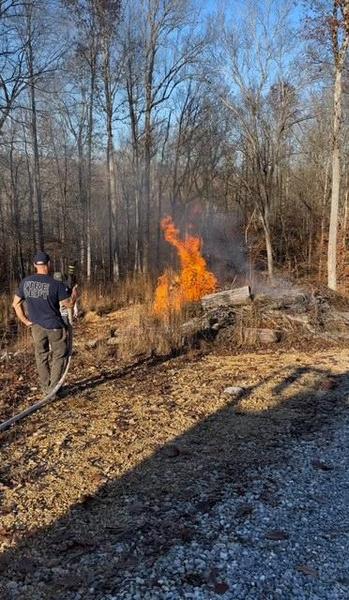
We have accumulated a big burn pile over the last several years—fallen limbs and lumber remnants from land clearing and building. As we kept putting off the burn, we added
broken limbs from numerous storms, pruned blackberry canes and other large weeds.
The pile has grown bigger and bigger. With rain and passing years, the debris started to decompose and fill itself in, except for a
few good "caves" that critters probably made their homes in.
Finally ready to eliminate what had become an eyesore, we secured our burn permit and notified the local voluntary fire department, which one of our
neighbors serves on. He came to look it over and said he'd like to have a truck here, because if it caught really well, it could be a huge blaze.
With the hose ready, we poured diesel fuel on it and lit it in
several places. After a few minutes of a big blaze, it quickly began to die down. We kept feeding the fire by adding smaller pieces that would ignite quickly, and as it subsided, we brought the bigger remnants closer in to stoke it some more.
With a lot of hands-on maintenance, the fire burned for about a day—until it rained. Amazingly, the day after it had quit raining, several pieces were still smoldering. So while it was hard to light and keep lit, it was resistant to go out, even with twenty-four hours of rain.
After several unsuccessful attempts in the days to follow to get it going again, we have given up for now. It is just too damp, plus ash and half-burnt debris have seeped deeper into the cracks between logs, further blocking out the airflow at the bottom of the pile.
Every trial has a gift, and I realized a few life lessons from our progress (and lack thereof) with the burn pile.
ONE: Create Room for Flow
If we are cramming so much into our days with no air in between, no breaks, no white space for happy accidents, coincidences and serendipity, we choke the “life” out of our life. Lack of oxygen and wiggle room brings restriction, constraint, and tension. There's no room to breathe life and spontaneity into anything. No airflow means no flow.
When we carve out holes in our calendar for breathing room and for divine intervention and inspiration, organic flow returns. We may set our days up with a plan, much like we build a fire with intentional space between logs, but once we’ve done our part, we step back and let “the fire” have its way. So much more is possible when we're surrendered
into the flow.
TWO: Ongoing Maintenance
Once the fire stopped burning, we were able to rearrange the wood to create renewed openness and a path for the fire to travel. Life isn’t one and done. Even a well-built plan will require consistent evaluation and maintenance, much like a fire
needs stoking to keep burning.
If we want red-hot inspiration to wind its way through our lives, we must regularly clear the path, loosen what’s become stuck, and feed the fire. We have to create a way for passion and
momentum to reach the most internal recesses of our souls, where the years and debris have piled up.
THREE: Resilient Rewards
The reward of frequently monitoring and managing the projects, goals and relationships we care about (aka good fire-tending) will cause a well-lit desire to
keep burning, even when confronted with significant obstacles. The more we keep our passions and goals ignited, the harder it is for a down pour to extinguish our flames of purpose and intention.
CONCLUSION
Today we ask ourselves:
Where is the flow in our lives being blocked, even if simply by too many good intentions?
Where do we need to clear the way and step back?
How could what we're looking for show up if we made more
room for it?
How great would it feel to have more of God's divine flow touch all parts of our lives, not just the surface layers we allow to be visible?
Lastly, let’s notice what is burning well, due to our dedication and persistent efforts. Congratulate ourselves for keeping the important fires lit, and give thanks for divine assistance.